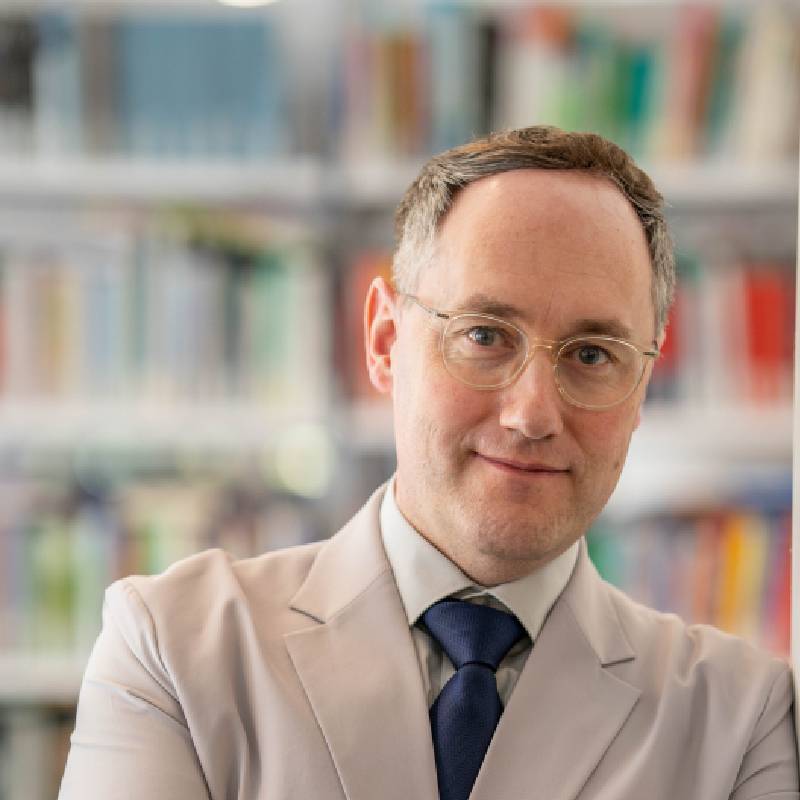
Dr. Waiguny, your professional career has taken you from Klagenfurt via New Zealand, the USA and many other international locations back to your home country. What is your perspective on Carinthia as an educational location today?
Dr. Martin Waiguny: I think we sometimes hide our light under a bushel. The people in Carinthia are incredibly innovative and, above all, very accessible. This is an asset that we could emphasise even more in an international comparison. Over the past 20 to 30 years, the range of courses available at all four universities has developed enormously. Today, we are both strongly positioned in exciting niches and broad enough to compete internationally.
Practical orientation is a hallmark of Carinthia University of Applied Sciences. How is it possible to link course content with the needs of regional companies and global trends?
Dr. Martin Waiguny: I have to say a big thank you to our lecturers and professors. We have an exceptionally strong involvement of regional, national and international companies in teaching – from guest lectures to extensive project work carried out by students. As a result, we are not only closely networked with the real economy, but also make an important contribution to future value creation in the region.
Carinthia University of Applied Sciences has had a strong international focus for years. What strategies are you pursuing to attract international students and retain them in the long term?
Dr. Martin Waiguny: A bundle of measures is certainly necessary here. This includes, for example, the further expansion of English-language courses – English is the lingua franca in science. At the same time, we have to plan holistically as well as consider issues such as student housing and living. We are in constant contact with local decision-makers and providers. International examples show that if students feel comfortable at their place of study, they often stay. This turns a potential brain drain into a real brain gain.
What do international students particularly appreciate about Carinthia?
Dr. Martin Waiguny: Carinthia scores highly with students thanks to its diverse nature and numerous outdoor activities. Its proximity to Italy and Slovenia is also an advantage. In future, Styria will also move even closer to the Alpine-Adriatic region. This will enable us to form a new metropolitan region, which will further increase its attractiveness for students.
As an active partner in location communication, CUAS also contributes to joint campaigns to position Carinthia as an innovative region for education. What is particularly important to you?
Dr. Martin Waiguny: It is particularly important to me to make the extraordinary diversity of the Carinthian economy visible. This range is usually only found in large cities. Everything is represented here, from precision technology and manufacturing industry to a wide range of services – and with international players. This is a huge advantage for students who are still developing their professional orientation.
In which subject areas does Carinthia University of Applied Sciences currently see particularly high demand – both from students and from the business world?
Dr. Martin Waiguny: All four of our faculties are currently working at full capacity. With around 3,000 students, we have reached a new high. This shows that both our established and new degree programmes, which we always develop with the involvement of industry, are highly relevant. We are particularly pleased with the strong demand in the technical degree programmes, where demand from regional, national and international businesses is consistently high.
Which current projects or initiatives are examples of how the university and the region benefit from each other?
Dr. Martin Waiguny: One current example is the new dual orientation of our hotel management course. Students learn at so-called third learning locations, i.e. directly in hotel and catering businesses, and are also employed there. Unlike traditional internships, there is a clear thematic focus here. This is a very attractive model, especially for Carinthia as a tourist destination.
Our initiatives also range from ageing research at the IARA research centre and biodiversity projects to new working environments and innovative building materials. It would go far beyond the scope of this interview to list them all. We are one of the most active research universities of applied sciences in Austria, with direct added value for Carinthia.
In your opinion, what is Carinthia particularly good at as a university location, also compared internationally?
Dr. Martin Waiguny: The moderate size of the four universities gives Carinthia a very personal touch, which is very attractive for students. The short distances both within and outside the universities are certainly a plus point. And as a historical crossroads of different cultures, Carinthia is very adaptable and internationally open.
If you look ahead to the next few years: What development would you like to see for Carinthia University of Applied Sciences and Carinthia as an educational location?
Dr. Martin Waiguny: Within the next few years, I hope that all four universities will have developed genuine thought leadership in clearly defined areas or niches, i.e. that they will be perceived internationally as the first port of call for certain topics.
I would like Carinthia University of Applied Sciences to be a university of opportunity and conscious choice: a place that students, teaching and research staff choose specifically because they see excellent prospects for education, research and work here. We will work consistently on this and continue to build on our strengths.